

Quick Answer
A one-person business continuity plan records what must keep happening when you cannot work normally, who is authorised to help, how essential information can be recovered and which commitments must pause. Start with the next client deadline and a realistic fallback. A contact name or backup drive alone does not make the plan workable.
For a freelancer, the most important dependency may be the owner. Illness, an inaccessible workspace, a broken laptop or a provider outage can interrupt delivery even when client demand is healthy. I would prepare a small usable plan before buying a complex continuity system. This guide is an operational starting point; it does not create legal authority, insurance cover or specialist emergency arrangements.
Copy the continuity plan template
Use short project identifiers and point to protected records. Keep this plan available through an appropriate fallback if your normal device or account is unavailable. A broadly shared copy should not contain passwords, recovery codes, banking details or confidential client files.
BUSINESS CONTINUITY PLAN
Business / plan owner:
Version and last checked date:
Restricted copy location and fallback access:

1. ACTIVATION
Disruption this version covers:
Who can activate it and how they are contacted:
First decision / next review time:

2. CRITICAL COMMITMENTS
Client or function:
Next commitment and actual agreed deadline:
Consequence of delay:
Minimum acceptable service / safe pause:
Dependencies (person, device, account, supplier):

3. AUTHORISED HELP
Named person and verified contact:
They have agreed to help: yes / not yet
Actions specifically permitted:
Actions excluded / approval needed:
Client, contract or provider permissions to check:

4. ACCESS AND RECOVERY
Essential record or service:
Approved access route (reference only, no secrets):
Fallback if the usual device or account fails:
Backup owner / location / last successful restore check:
Missing dependency and next action:

5. COMMUNICATION
Who needs a message and by when:
Who sends it:
Working alternative contact route:
Known impact / realistic next update:

6. MONEY AND ADMIN
Invoices, payroll if relevant, bills or filings needing attention:
Authorised contact / adviser / existing arrangement:
What cannot proceed without the owner:
Policy or contract reference to check (no assumed cover):

7. RESTART
Safe-to-resume checks:
Who confirms access, files and commitments:
Backlog to renegotiate:
Temporary access to remove:

8. EXERCISE AND REVIEW
Scenario and date:
What was actually attempted:
What worked / failed / remains unknown:
Action, owner and due date:
Next review date or change trigger:
This is the same blank structure supplied in the download. Complete one realistic scenario first. “Owner unavailable for three working days” is more useful than listing every possible disaster without a response.
Choose the work that cannot simply wait
List the commitments due during the disruption: a delivery, client update, payment process or important filing. Separate contractual deadlines from your preferred dates. Record the consequence of delay and what the smallest acceptable service would be. Avoid labelling every task critical; a portfolio redesign can usually wait while a promised delivery needs a decision.
Local-authority continuity guidance provides a useful planning framework, but your service, contracts and responsibilities determine the details. This short template does not establish compliance with a continuity standard. Where you employ people, handle regulated work or provide a safety-critical service, obtain the appropriate specialist input.
Find the dependency behind each commitment
Write what must be available before delivery can happen. A file in cloud storage may still depend on one phone for sign-in. A helpful colleague may lack permission to handle a client's information. A backup may exist without a demonstrated restore. Record those as unresolved dependencies rather than assuming the fallback is ready.
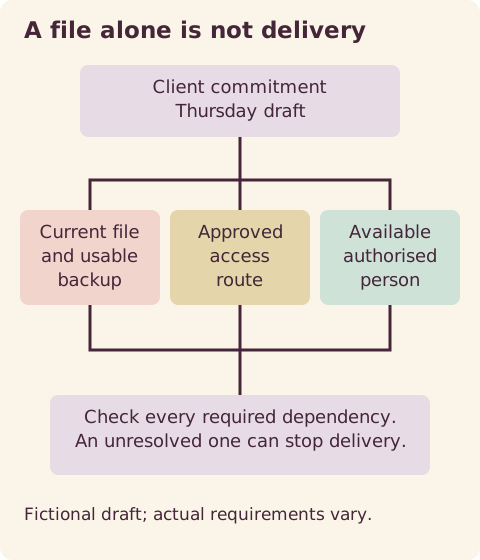
The NCSC's small-business backup guidance recommends regular backups of important information and checking that restoration works. Keep a protected backup separate from the original device. An ordinary sync folder can replicate an unwanted change, so check what recovery history and independent backup your arrangement actually provides.
Test with an appropriate non-sensitive sample and record what you restored, from which backup and when. Seeing a filename is not the same as opening a usable restored file. Do not perform an experiment on the only copy of a live client project.
Worked example: an unavailable freelance designer
Fictional example: Jo has a draft presentation due on Thursday and becomes unavailable on Tuesday. An independent designer has agreed to be an emergency contact, but has no authority to change prices or access client accounts. These are invented circumstances, not a reported client incident.
| Commitment | Dependency or limit | Practical response |
|---|---|---|
| Thursday draft | Jo's working file and judgement are needed. | Tell the client the impact; propose a realistic revised date. |
| Client update | Emergency contact may relay a pre-agreed status message only. | Use the agreed contact route; disclose no private health details. |
| Another designer finishes | Skills, availability, permission and data access are not confirmed. | Do not promise a substitute until those conditions are resolved. |
| Restore the file | A backup exists; opening the restored format still needs checking. | Verify a usable copy through the approved recovery arrangement. |
The safe fallback may be a clear pause rather than continued production. The emergency contact can reduce uncertainty without pretending to be Jo or making commitments on Jo's behalf. Use the handover record to identify current files and outstanding approvals, rather than searching through every email during the disruption.
Agree help and access before you need it
Ask a proposed helper whether they are willing and realistically available. Specify what they may do, the route they will use and what needs further approval. Use supported individual or delegated access where appropriate, with the minimum permissions required. Do not share a personal sign-in or put recovery secrets in an emailed planning sheet.
A plan cannot override client confidentiality, subcontracting terms, account-provider rules or legal restrictions. Check the contract checklist and get qualified advice where authority is uncertain. A relative knowing where your laptop is does not automatically authorise them to manage the business or move money.
The ICO's security principle remains relevant when personal information is involved. A fallback should preserve appropriate access controls. If information may have been lost or exposed, assess the incident and any notification duties promptly with suitable advice; do not assume this template resolves them.
Continue, delegate or pause?
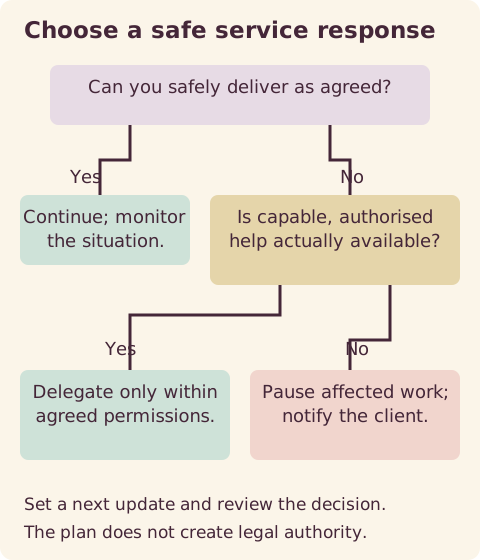
Continue only when the necessary capability and access are safe and available. Delegate only within actual authority, competence and relevant permissions. Otherwise pause the affected commitment and communicate. Do not let a plan's optimistic recovery date become a promise before the dependencies have been checked.
Subject: Update on [project / commitment]
Hello [name],
[Brief relevant disruption] affects [specific agreed work].
The current position is [what is known].
I propose [realistic revised delivery or safe pause].
Please use [working contact route] for urgent project questions.
I will update you by [specific date/time], even if the position is unchanged.
[Name and accurate role]
Say what is known and what is still being checked. Include a new update time rather than promising an unverified recovery. Agree any change to scope or timing through the existing process. The client-boundaries guide provides related wording for availability and changes.
Try the plan, then record the gap
Run a modest tabletop exercise: suppose your laptop is unavailable and you must identify tomorrow's client commitment. Can you find the correct contact, current approved file and alternative communication route using only authorised access? In a separate recovery exercise, check that a sample backup restores. A discussion is useful, but it is not proof that a restore or delegated account access worked.
Record the actual exercise date, result and next repair. Revisit the plan when a client, helper, device, account, supplier or important commitment changes. Insurance wording, exclusions, notification conditions and continuity cover need checking against the actual policy; no payment or coverage is assumed here.
Restart against the work you can really deliver
Before returning to normal service, check file integrity, working access and the commitments that accumulated. Confirm changed dates with clients, remove temporary access that is no longer required and record what failed in the plan. Use the weekly planning template to allocate the backlog without promising the same hour twice.
Start by completing one critical-commitment row and resolving its biggest dependency. Then test that response before describing it as ready. If grief or another personal crisis is the reason work has become difficult, the separate business-while-grieving guide offers a gentler support-first approach; this operational sheet does not replace that support.
Sources
- Islington Council: Continuity guidance and plan outline for small businesses
- NCSC: Backing up your data
- ICO: Security principle
Initial source checks: 2 November 2026. External information can change.
Spot something that needs correcting? See the corrections process.