

Quick Answer
A useful project status report tells the client what is complete, what is happening next, whether the current delivery date is still credible and which decision or input is needed from them. Date the report, name the reporting period and assign each open action to an owner. Keep forecasts distinct from agreed commitments. A progress email does not, by itself, change the contract, approve extra work or establish acceptance.
Download the editable project status report
“Work is progressing well” may reassure a client briefly, but it gives them little to act on. I would rather send a shorter update that identifies one finished deliverable, one dependency and the next decision. The reader should be able to tell whether they need to do anything without searching through a diary of your week.
This guide covers delivery after the project has started. Use the onboarding checklist for start conditions and the handover template for closeout. This report is the recurring client-facing snapshot between those stages; your weekly planner remains the internal capacity plan.
Copy the project status report template
The download is plain text, with no signup required. Paste it into a document or email. Remove sections that do not change a decision, but keep the date, current forecast, client action and next update. Link to the actual scope or working file rather than maintaining several contradictory copies.
PROJECT STATUS REPORT
Project / client:
Report date / reporting period:
Scope or plan version:
Overall position: on track / at risk / blocked / awaiting decision
Summary: [what changed and what that means for delivery]

COMPLETED SINCE THE LAST REPORT
Deliverable | Finish condition met | Evidence / file version

NEXT WORK
Task | Owner | Planned finish | Dependency

DATES
Agreed milestone / date:
Current forecast / assumptions:
Change requiring agreement, if any:

DECISIONS OR INPUTS NEEDED
Decision / input | Owner | Needed by | Effect if late | Next action

RISKS AND CURRENT ISSUES
Risk: [uncertain future event and possible effect]
Issue: [what has already happened and its actual effect]
Response / owner / next review:

SCOPE AND MONEY, WHERE RELEVANT
Agreed fee / approved changes:
New request awaiting a decision:
Invoice/payment status, kept separate from delivery:

Next update / channel:
Immediate contact for an urgent blocker:
Choose labels both sides understand. A supplier's timesheet, an invoice and this report answer different questions. Hours recorded do not prove a deliverable is finished, and a delivered file does not prove it has been accepted or paid for.
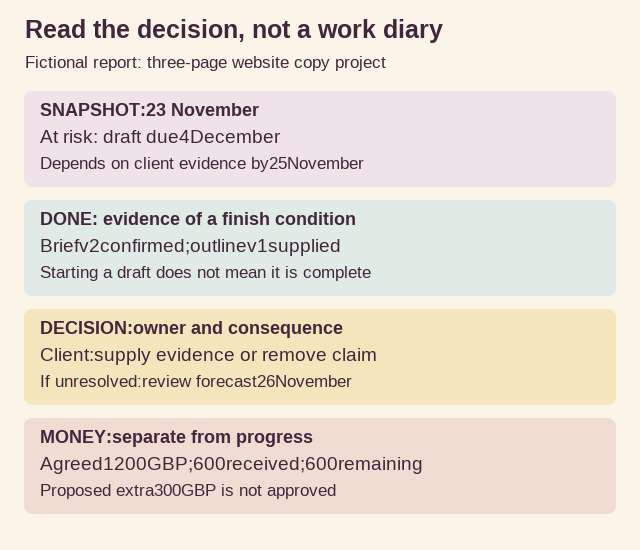
A completed fictional client update
Fictional example: Alex Example is writing three website pages for a small design studio. The agreed fee is £1,200 and the first draft is due on 4 December 2026. The client is due to supply evidence for a service claim by 25 November. Nothing below describes a real client, measured performance or an actual contract.
| Report field | Useful entry |
|---|---|
| Overall position | At risk: the 4 December draft date depends on receiving the remaining claim evidence by 25 November. |
| Completed | Audience and offer confirmed against brief v2. Page outline supplied as outline v1 on 20 November. Drafting has started; the three-page draft is not complete. |
| Next work | Alex drafts the homepage and contact page. Service-page claims remain provisional until the client provides supporting evidence. |
| Client decision | Studio owner to supply evidence or agree removal of the unsupported claim by 25 November. If neither happens, Alex will send a revised forecast and options on 26 November. |
| New request | A fourth page has been requested. Proposed additional fee: £300. No approval recorded; it is excluded from the present delivery commitment. |
| Money | £600 upfront received; £600 remaining under the agreed payment terms. The unapproved £300 request is not an agreed receivable. |
| Next update | 26 November, or sooner if the dependency changes the delivery outlook. |
The arithmetic is deliberately separate from progress. The current agreed project fee remains £1,200, with £600 received and £600 remaining. If the extra page were approved at £300, the revised total would be £1,500 before any applicable tax. That conditional calculation does not establish approval, an invoice due date or a right to start the additional work.
I would avoid saying the project is “two-thirds complete” because two of three pages have been touched. Pages can require different amounts of work, and an unfinished approval or evidence check may control the whole delivery. If you use a percentage, define what it measures and how it is calculated; do not present it as a probability of meeting the deadline.
Use status labels to describe a decision
- On track: the current forecast meets the agreed milestone under the stated assumptions. This is an assessment, not a guarantee.
- At risk: an unresolved dependency or uncertainty could move the milestone. Name it and say when action is needed.
- Blocked: a specific task cannot proceed. State which task, why and what would release it. Other work may still continue.
- Awaiting decision: an identified person needs to choose between clear options. Explain the effect of waiting.
These are suggested editorial definitions, not a certification scheme or a universal traffic-light standard. Agree your own meanings at onboarding. Never rely on colour alone: write the condition and its consequence in ordinary words.
Government project guidance describes reporting as a regular summary for decision-makers and distinguishes issue records from risk management. The Department of Finance planning guide concerns a larger governance setting; the shorter format here is my adaptation for a small freelance service project, not its official template.
Turn a missing input into a useful decision
“Waiting for feedback” is a status without an owner or consequence. Replace it with: “The studio owner needs to consolidate feedback on outline v1 by 25 November. Drafting the service page depends on that choice. If feedback arrives later, we will review the forecast before confirming a new draft date.”
A client delay does not automatically shift every deadline by the same number of days. Your next available work slot, other dependencies and the agreement matter. Offer specific options, record the choice and keep the original commitment visible until a change has actually been agreed.
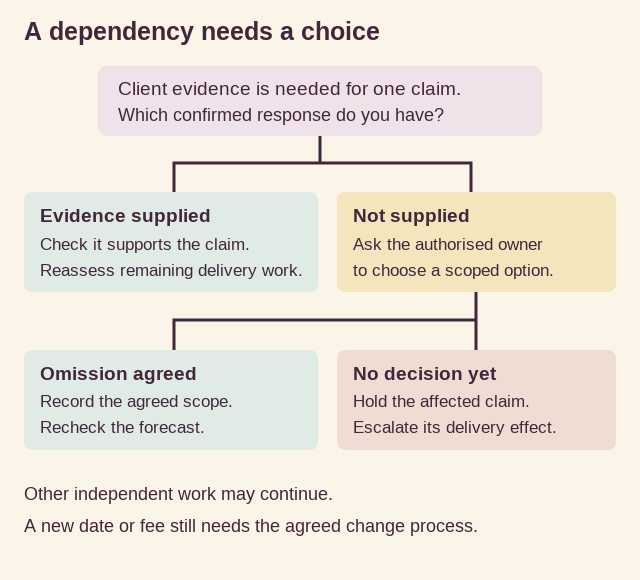
If a request changes the deliverable, fee, revisions or responsibility, handle it through the agreed change process. Use the client-boundary scripts to state the options professionally, and check the contract checklist when the underlying terms are unclear. Do not treat silence after a status email as acceptance of a new fee or date.
A short status email you can adapt
Subject: [Project] update: [main decision or delivery position]

Hi [name],

Since the last update, [specific deliverable] is complete against
[finish condition]. The current file is [version / private link].

The next milestone is [agreed item/date]. My current forecast is
[date], assuming [specific dependency].

I need [person] to [input/decision] by [date]. If that is not possible,
the options are [realistic options]. Please confirm which you prefer.
The extra request [description] remains outside the agreed scope
until we confirm its fee and delivery effect.

I will update you again on [date], or sooner if this outlook changes.
[Name]
Remove irrelevant clauses rather than sending an alarming template unchanged. For a tiny task with no dependency or scope change, a few clear sentences can be enough. For several owners or decisions, use the report and link to the supporting records.
Agree a reporting rhythm that suits the work
Weekly updates can suit an active multi-week project. A short assignment may need only a start confirmation, a decision-point update and delivery. High-impact news should not wait for the next routine email. Agree the channel, recipient, frequency and who covers absence at the start.
A practical check is whether the recipient can answer: “What changed, what happens next, what do I need to decide, and when will I hear again?” A long activity list does not necessarily answer any of those questions. Keep internal task chatter in your working records and summarise its effect on the client.
Keep the report useful and appropriately private
Use a dated version and restrict supporting-file access to people who need it. Include enough evidence to explain the status, without copying sensitive client records, credentials or entire inbox threads. If personal information is involved, the ICO's data-minimisation principle is a useful check: the information should fit the stated purpose and not exceed what is needed. Your actual access, retention and lawful-basis decisions depend on the circumstances.
A document and email can be sufficient while the number of open decisions is small. Add a project system when ownership, versions or follow-ups have become difficult to manage, and evaluate that specific problem before buying software. Sending a report is not evidence that the recipient received, read or agreed with it; record material decisions through the agreed process.
Finish with one clear next step
Prepare the report from your actual work record, identify the decision that could change delivery and make the next update date explicit. At closeout, move the final files, acceptance and remaining actions into the handover record. Keep delivery, permission, invoicing and payment distinct throughout.
Fill in the project status report
Common questions
Is a status report the same as a project plan?
No. The plan describes intended work and dependencies. The status report compares the current position with that plan and highlights changes and decisions. Link to the authoritative plan version rather than rewriting it in every update.
Should I include hours worked?
Include them when they are relevant to the agreement or a budget decision, with a clear reporting period. Explain whether they are recorded, billable, approved or invoiced. Hours alone do not measure completion or establish an amount payable.
What if nothing has changed?
Say that plainly and confirm the next milestone and update date. Recheck assumptions rather than recycling an old “on track” label. If there is no useful decision or reassurance to provide, agree a less frequent cadence.
Sources
Initial source checks: 23 November 2026. External information can change.
Spot something that needs correcting? See the corrections process.