

Quick Answer
Choose a free business course for the decision you need to make next. OpenLearn offers a fuller entrepreneurship course and an introductory bookkeeping course; HP LIFE offers a shorter cash-flow course. Check the study time, account requirements and completion evidence before enrolling. Then reserve time to apply one lesson to your own business. A certificate alone does not establish professional competence or customer demand.
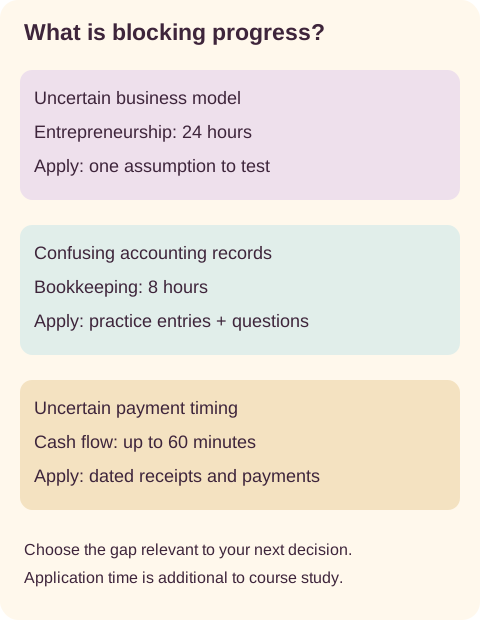
A long course list can become another way to postpone a difficult business task. For a UK freelancer or one-person service business, I would first name the gap: an untested offer, confusing records or uncertainty about when money will arrive. The three routes below answer different learning needs. Their order follows those tasks, rather than a score or a claim that one provider is best for everyone.
These are online learning options available to UK readers, not a list of accredited UK qualifications. Provider details were checked on 9 November 2026. Course completion, account access and your own results still depend on what you actually do.
Choose by the task blocking progress
| Your immediate question | Course and published study time | Output to make afterwards |
|---|---|---|
| How does this idea become a workable business? | OpenLearn: Entrepreneurship, from ideas to reality. 24 hours; intermediate. | A revised business model with one assumption to test. |
| What do the bookkeeping records mean? | OpenLearn: Introduction to bookkeeping and accounting. 8 hours; introductory. | A worked practice record and questions for your bookkeeper. |
| Will cash arrive in time for payments? | HP LIFE: Cash Flow. No more than 60 minutes; self-paced. | A dated cash-in and cash-out plan. |
The outputs in the final column are my suggested application tasks, not promised course deliverables or trading results. Published study time is an estimate for the course; allow extra time to practise, check your understanding and apply it.
For shaping an idea: OpenLearn entrepreneurship
Entrepreneurship, from ideas to reality covers business models, resources and planning through case studies. OpenLearn lists 24 hours at intermediate level, so this is a more substantial commitment than a short introduction. I would choose it when the connections between customer, offer and delivery are unclear. If you already know the model and need one immediate finance skill, start with that narrower gap.
You can read the course without registering. An account is needed for progress tracking and the full participation activities. The course offers a participation statement and a digital badge after the relevant completion requirements. OpenLearn distinguishes its badge from academic accreditation; this particular course also lists CPD Standards Office recognition and 24 CPD points. Neither should be described as an Open University degree or a professional licence.
After the relevant learning, revise the one-page business plan. Mark what you know, what you assume and what evidence would change your mind. If the customer problem is still a guess, use the idea-validation questions with plausible buyers. Completing course exercises cannot substitute for that evidence.
For understanding records: OpenLearn bookkeeping
Introduction to bookkeeping and accounting is an eight-hour introductory course covering numerical skills, double-entry records and financial statements. It is a useful starting point when accounting language makes it hard to understand your records or ask informed questions. Its page was last updated in April 2020; the foundational subject remains useful, but I would not use it as current tax or filing guidance.
The material can be read without an account; registering enables progress tracking, all activities and a free statement of participation on completion. That statement records learning participation. It does not establish that you are qualified to advise clients or that your own accounts are correct.
Practise with invented transactions before applying unfamiliar entries to live records. Keep the original evidence and ask a suitably qualified adviser about your business's actual treatment. If your immediate problem is producing a first payment request, the first-invoice guide is a more direct task route. Learning the concepts and sending an accurate invoice are related but different jobs.
For payment timing: HP LIFE Cash Flow
HP LIFE's Cash Flow syllabus lists a self-paced course taking no more than 60 minutes. It focuses on monitoring cash, making decisions about available money and using a spreadsheet. I would consider it for a first cash-planning exercise when the problem is timing receipts and payments. It is a general business-skills course, not UK tax instruction or a personalised financial forecast.
HP LIFE says its courses and completion certificates are free. Registration is required before enrolling. Its programme help page says all lessons must be finished for a certificate and that these certificates are not accredited or endorsed by educational bodies. Do not describe one as an accredited accounting qualification.
Fictional illustration: an owner starts a week with £200, receives £600 and pays £500. Closing cash is £300: £200 + £600 − £500. A separate £400 invoice remains unpaid and is excluded from receipts. This is only a cash-movement example, not a profit calculation; no tax, VAT, borrowing or other movements are included. A business can issue an invoice without yet having the money available to spend.
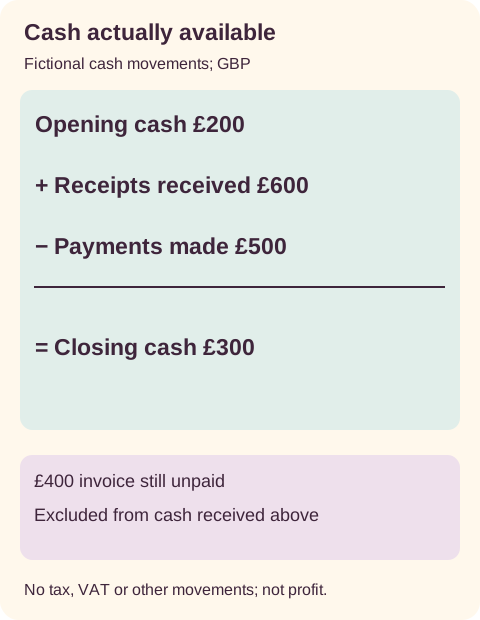
Apply the lesson by listing the actual dates and uncertainties behind expected receipts and payments. Keep an unpaid invoice distinct from a bank receipt, and check the underlying record. If money is already overdue, the invoice follow-up process addresses that task. A more attractive forecast does not make a late payment arrive.
Check free access, completion evidence and fit
- Check the exact course. A provider may offer both free and paid study. Confirm the syllabus, level and access conditions on the course page, rather than assuming the whole catalogue is free.
- Separate tuition from other costs. Check assessment, certificate, subscription, trial and software requirements before entering payment details. None of these three routes requires buying our software recommendation.
- Identify the completion evidence. Record whether you receive a statement, badge, certificate or recognised qualification, and what must be completed. If an employer or professional body has a requirement, ask whether this exact course satisfies it.
- Check practical access. Look for suitable formats, captions, transcripts and device requirements. Try a sample before committing a large amount of time; a provider's availability statement does not prove it works with your particular assistive setup.
- Check regional and current-rule limits. Funding schemes may have age, residency, employment or location conditions. General business learning does not settle current UK tax, legal or regulated-profession obligations.
You do not need to enrol in all three. An urgent statutory, payment or client deadline may need direct action or qualified help first. For peer contact and local support rather than a course, use the separate UK business networks guide.
Copy a learning-to-action plan
Use a document you already have. The complete editable version is available from the opening download. Keep confidential client material, account credentials and financial records out of a broadly shared learning sheet.
LEARNING-TO-ACTION PLAN
Business question I need to answer:
Why this matters now / real deadline:
Skill gap rather than missing decision or permission:
Chosen course / exact provider URL:
Course level and published study time:
Free access, account and completion-evidence conditions checked on:
Study blocks I can actually keep:
Separate practice / application blocks:
One useful output I will create:
Evidence or source I must check before using it:
Question needing a qualified adviser or actual customer:
Review date:
What I completed / what remains:
What changed in my business decision:
Continue, choose different learning, or act on the output:
For example, a fictional owner chooses the eight-hour bookkeeping course and reserves four two-hour study blocks. That is eight hours of study, not eight hours including all practice. They separately reserve time to work through a sample and list questions for their bookkeeper. If their available week cannot accommodate it, they spread the learning out rather than relabel an unfinished course as complete. Use the weekly planning template to check the capacity.
Start with one question and one usable output
My starting choice is the narrowest course that addresses the obstacle you can name. Choose the fuller entrepreneurship route for an uncertain business model, bookkeeping for the record concepts, or cash flow for receipt and payment timing. After one study block, check whether you can explain something more clearly or make a better-supported decision. Change the learning route if the syllabus does not match the gap. Keep the useful output and its limits alongside any completion certificate.
Sources
- OpenLearn: Entrepreneurship, from ideas to reality
- OpenLearn: Introduction to bookkeeping and accounting
- The Open University: Free course access and participation statements
- HP LIFE: Cash Flow course syllabus
- HP LIFE: Free access, registration and certificate conditions
Initial source checks: 9 November 2026. External information can change.
Spot something that needs correcting? See the corrections process.