

Quick Answer
Good newsletter content ideas start with a decision your reader needs to make: what to prepare, which option to choose, what mistake to avoid or whether your service fits. Choose one question, give a usable answer and offer one relevant next step. Plan four distinct issues before promising a frequency you cannot maintain. Keep recurring newsletters separate from the welcome messages that new subscribers receive automatically.
If you run a small service business, a newsletter can become a monthly demand to “say something interesting”. I would give it a narrower job: help a suitable future client take one sensible step. You can do that with a short, specific example rather than a large round-up of other people's news.
This guide is for an ongoing newsletter sent to people you can lawfully contact. The email-list setup guide covers signup and platform decisions; the welcome sequence guide covers the first messages after joining. Here, the task is deciding what to send once that welcome is over.
Start with the promise your reader joined for
Write one sentence: “I help [specific reader] make [specific decision] through [type of useful email].” For example, a website copywriter might promise small studios one practical briefing tip twice a month. A sudden stream of unrelated software promotions would fail that promise even if each product were legitimate.
Choose the reader before brainstorming topics. Use the ideal customer profile worksheet if “small businesses” is still your whole audience definition. Record a real question from a call, enquiry or support exchange, then remove names and confidential details. Do not publish a client story or quote without the necessary permission. When permission is unavailable, create a clearly labelled fictional example rather than disguising identifiable work.
Six repeatable newsletter ideas with a clear reader job
| Format | Service-business example | Useful next step |
|---|---|---|
| Answer one recurring question | “What should be ready before a website-copy project?” | Check a short brief against the example. |
| Explain a choice | “Should your service page cover one audience or several?” | Choose one route using stated conditions. |
| Show a worked example | A fictional vague paragraph rewritten with a clearer audience and service. | Rewrite one sentence of the reader's own copy. |
| Prevent a specific mistake | “Why collecting testimonials at the last minute can delay launch.” | List the evidence and permissions still needed. |
| Offer a small reusable tool | A briefing checklist with five necessary inputs. | Use it for the next project, without buying anything. |
| Explain service fit | What a fixed-scope copy project includes, excludes and needs from the client. | Enquire only if those conditions match. |
A point of view can work too, but give it a consequence: explain which decision changes if the reader agrees. “Here is what I think about business” gives them less to use than “If your offer is still changing, postpone the full website rewrite and test the service description first.” Avoid making a universal rule from one anecdote.
A four-issue plan for a fictional copywriter
Alex Example is a fictional independent copywriter serving small design studios. Subscribers were promised website-briefing tips twice a month and occasional service offers. The following eight-week plan is an editorial example, not a tested schedule or a claim about conversion rates. Replace it with the frequency and subject your own subscribers expect.
| Issue | Subject and useful content | One primary action |
|---|---|---|
| 1: Prepare | “Before you book website copy: five inputs to find.” Explain the audience, offer, page list, evidence and approver. | Complete the briefing checklist. |
| 2: Choose | “One service page or two?” Compare a shared audience/problem with genuinely different buying needs. | Mark which branch fits the reader's offer. |
| 3: Practise | “Make your opening sentence more specific.” Show a fictional before-and-after, with reasons for each change. | Rewrite one opening sentence. |
| 4: Decide fit | “When a fixed-scope copy project is ready to start.” State prerequisites, deliverables, exclusions and how an enquiry works. | Read the service outline if ready. |
Each issue should stand alone: people may join later or skip an email. Link to a useful earlier resource when necessary, rather than requiring them to reconstruct a whole course from their inbox. Keep essential instructions in the email or an accessible page, not solely in an image.
Budget for production honestly. If each issue takes an assumed 45 minutes to draft and 15 minutes to check, four issues require four hours. That excludes creating new resources and replying to readers. These are planning inputs, not measured production times. If four hours will not fit, reduce frequency or scope before announcing the schedule.
Turn an idea into an email people can use
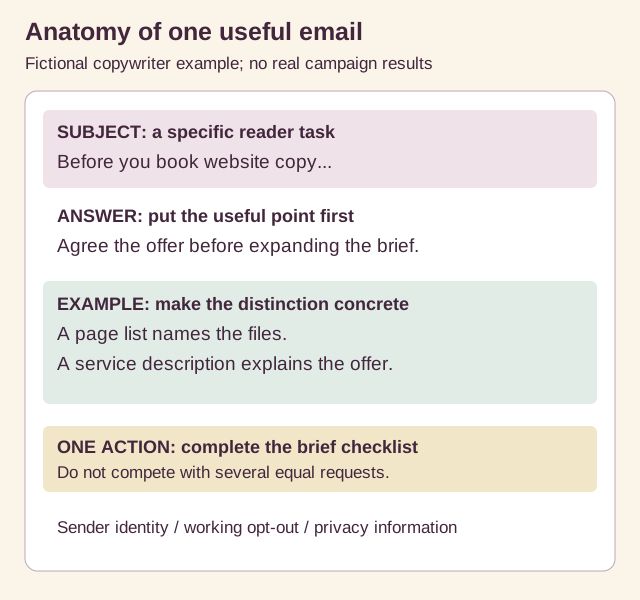
Here is an original fictional outline for issue one. It demonstrates structure; adapt it to your own verified offer and reader promise.
Subject: Before you book website copy, find these five inputs

A copy project can stall when the writer has a page list but no agreed offer.
Before asking for a quote, gather:
1. The audience you are trying to reach.
2. The service and what is included.
3. The pages you need.
4. Evidence for claims you want to make.
5. The person who can approve the final copy.

For a fictional three-page studio site, “home, services, contact” describes
the files. It does not explain which service the studio wants enquiries for.
Write that service in one sentence before expanding the page brief.

Your next step: use the briefing checklist to mark what is ready and what
still needs an owner. There is no need to book a project to use it.
Your actual email also needs an accurate sender identity, a working opt-out and suitable privacy information. The outline is not a full compliance template. A restrained service invitation can appear when relevant, but do not give the reader several equal-weight tasks such as “reply, book, download, follow and share”. Choose the action that follows naturally from this issue.
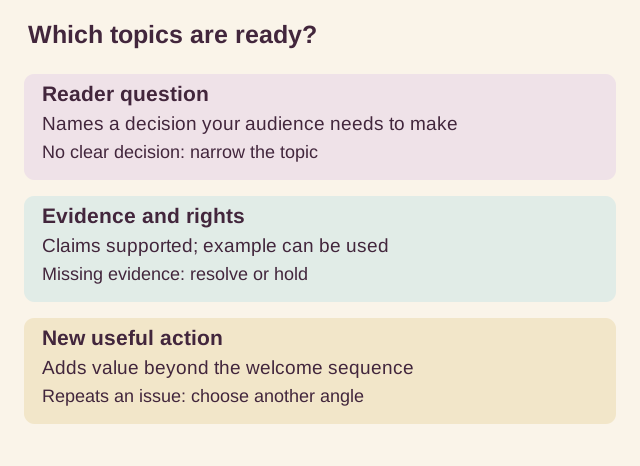
Use a topic filter before adding it to the calendar
- Reader fit: can you name who needs the answer and the decision it helps?
- Evidence: can you substantiate the factual claims and use the example or media legitimately?
- Distinct value: does this issue do something different from the last email and welcome sequence?
- Action: can the reader do one useful thing after reading, even if they never buy?
- Capacity: can you create and check it within the time available?
Hold a topic with an unsupported price, unapproved client example or unresolved technical claim. Research that specific gap, remove the claim if it is unnecessary, or choose another useful topic. Do not turn private client correspondence into public “proof” because the calendar has an empty slot.
Keep permission and reader expectations intact
A useful tip can still be direct marketing when it promotes your business. Do not treat editorial presentation as an exemption. The ICO distinguishes corporate subscribers from sole traders and certain partnerships, which are treated as individual subscribers under PECR. Consent or a valid exception may be needed; a free download or a published email address alone does not establish it. Personal-data obligations can also apply to business contacts.
Use the ICO's B2B marketing guidance for the relevant subscriber category and conditions. Identify yourself, provide a valid opt-out, respect objections and screen against your suppression records. If your subject or frequency is changing substantially, review the permission and promise rather than assuming an old signup covers everything.
Collect only the personal information needed for your stated purpose. An idea bank usually needs the question and its context, not a copy of a client's entire record. The ICO's data-minimisation guidance is a useful check. Seek appropriate advice for your own circumstances; this plan is editorial guidance, not a legal assessment of your list.
Review replies and enquiries without mistaking them for sales
Record the issue, eligible audience, delivery information available from your provider, relevant replies, qualified enquiries, unsubscribes and follow-up window. An open, click or reply does not prove a sale. Tracking has its own privacy requirements; turning on every available metric is not a prerequisite for using this planner.
In a fictional issue sent to 80 eligible subscribers, four people reply and two enquire; one enquirer may also be a replier. That is 5% replying and 2.5% enquiring against the stated 80-person denominator. Do not add those percentages, treat 80 sends as 80 confirmed readers or describe the two enquiries as customers. Small counts and changing subjects are weak grounds for declaring one format a winner.
After four issues, ask which questions produced useful conversations, which took more work than expected and which audience needs remain unanswered. Keep the questions that help your actual readers. A quieter issue can still serve a valuable purpose; do not replace relevant advice with sensational subjects solely to chase a noisy metric.
Plan the next four issues
Write the reader promise, choose four different decisions and put one primary action beside each. Schedule the drafting and checking time in your weekly plan. If the signup journey or welcome is still unfinished, fix that foundation before increasing the sending frequency.
Download and fill in the newsletter planner
Common questions
How often should a small service business send a newsletter?
Choose a frequency you can sustain and that matches the promise made at signup. Twice a month is the fictional example here, not a universal recommendation or evidence that it outperforms monthly sending.
Can I reuse a blog article?
Yes, where you own the necessary rights and it answers the newsletter's question. Give readers a useful point in the email and a purposeful link for the detail. Check current facts and avoid sending only a headline with no explanation.
Does every issue need to sell something?
No. A checklist, worked example or decision guide can be the whole point. When you do invite an enquiry, make the service fit and conditions clear and keep it consistent with the permission and expectations of that audience.
Sources
Initial source checks: 16 November 2026. External information can change.
Spot something that needs correcting? See the corrections process.